Late Triassic · about 230 million years ago
The Science of the Triassic Algarve
A team is sieving some of the oldest red rock in southern Portugal for what it can reveal about the time when dinosaurs were new.
The Carnian Pluvial Episode
When the Rain Came
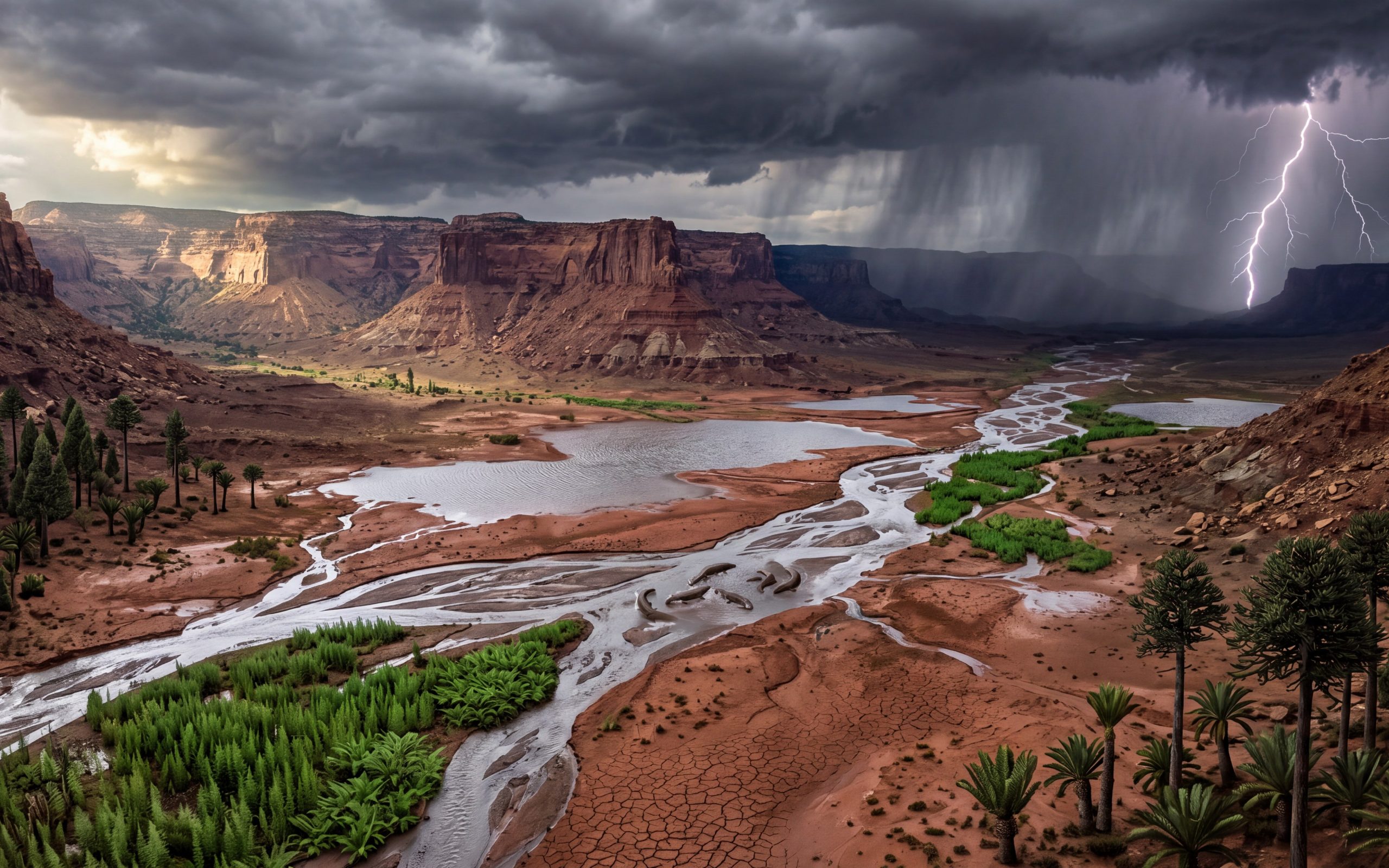
About 235 million years ago crocodile cousins were the top predators on land, and dinosaurs were rare. Then, between about 234 and 232 million years ago, volcanic eruptions loaded the air with carbon. The climate turned unstable, and rain fell on a supercontinent that had been mostly desert. Geologists call it the Carnian Pluvial Episode, and it came in several pulses over 1 to 2 million years.
Dinosaurs spread after it. A 2022 study in Nature, co-led by Romain David and Ricardo Araújo, found that the forerunners of mammals became warm-blooded at about the same time, and that the change took less than a million years.
How Old Is 230 Million Years?
Scroll down through the rock. Deeper is older, and the red beds of the Algarve lie near the bottom.
- Today You are here Our species is about 300,000 years old. On this scale, all of human history is the thin gold line at the top of this column.
- 66 million years ago An asteroid ends the age of dinosaurs Tyrannosaurus rex was among the last of them, 68 to 66 million years ago.
- About 130 million years ago The first flowers bloom
- About 150 million years ago Portugal's Jurassic giants Long-necked sauropods walk the coast of what is now central Portugal.
- About 180 million years ago The Atlantic Ocean begins to open
- 201 million years ago A mass extinction clears the way Crocodile cousins lose their hold on the land, and dinosaurs take over.
230 million years ago
The animals of these hills
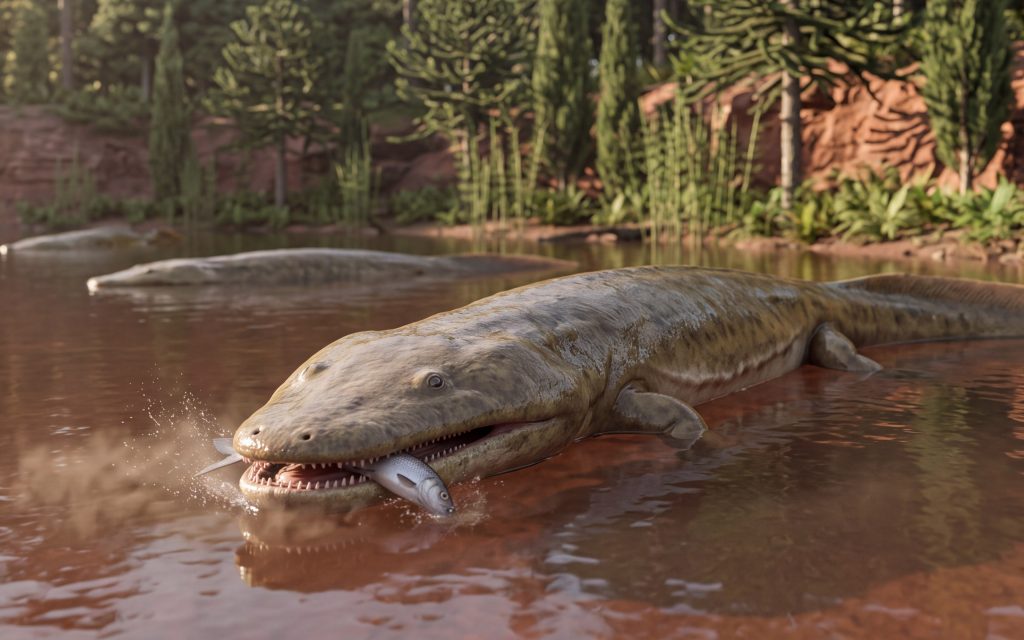
Amphibians up to 2 meters long fed on fish here beside crocodile-like phytosaurs, and dinosaurs were rare newcomers. This is the world the expedition is searching.
A few million years earlier, between 234 and 232 million years ago, rain had come to a supercontinent that was mostly desert.
What Lived Here
These hills are best known for Metoposaurus algarvensis, an amphibian up to 2 meters long with a flat head shaped like a toilet seat. A team led from the University of Edinburgh named it in 2015 from a dense bonebed holding many individuals. The same hills have produced a crocodile-like phytosaur and a turtle-shaped placodont. In 2025 the DinoDawn sieves added more than 100 small fossils, including possible early relatives of mammals, now being prepared for publication.
Why the Algarve
The best-dated fossils of the first dinosaurs come from Argentina and Brazil. Portugal’s share of the story has had far less study. Published work puts these beds at about 220 to 230 million years old, and this season the team is collecting fossil pollen to narrow that down.
How the Team Reads the Rock
Fossil pollen dates the beds and shows which plants grew here. The chemistry of the rock records the climate, and thin slices of fossil bone show how fast an animal grew.
Sources
- Brusatte, Butler, Mateus and Steyer 2015, Journal of Vertebrate Paleontology 35(3). Metoposaurus algarvensis.
- Mateus, Butler, Brusatte, Whiteside and Steyer 2014, Journal of Vertebrate Paleontology 34(4). The first phytosaur from Iberia.
- Campos and Mateus 2018, European Association of Vertebrate Palaeontologists, abstracts. The first placodont from Portugal.
- Araújo, David and colleagues 2022, Nature 607. The Late Triassic origin of warm blood in mammals.
- Bernardi and colleagues 2018, Nature Communications 9. Dinosaurs and the Carnian Pluvial Episode.
- Dal Corso and colleagues 2020, Science Advances 6. The Carnian Pluvial Episode.
- Witzmann and Gassner 2008, Alcheringa 32(1). Metoposaurid and mastodonsaurid amphibians from the Triassic-Jurassic boundary of Portugal.
- Russell and Russell 1977, Ciências da Terra 3. First results of a fossil survey in the Triassic of the Algarve.
- Palain 1976, Memórias dos Serviços Geológicos de Portugal 25. The Silves Sandstone, Triassic and Early Jurassic of Portugal.